


A Placemaking Journal
Life, Land Use, and Working With What’s Real



 October 23, 2026
I have a couple of things on my mind today, both about sustainable land use. They are different in that the first is mostly about improving city and close-in suburban neighborhoods, and the second is mostly about what’s happening well beyond traditional urban places. But the two topics are closely related in that I believe in both places we must let go of some ideology and pay more attention to real-world concerns and issues.
Let’s start with land use in the broad sense of the phrase. Throughout my life, I’ve been strongly engaged in thinking, both personally and professionally, about — and at times obsessed by — the subject of how we use land in America. I suppose that can happen when you grow up in a part of the country so blessed by nature as the Western North Carolina mountains, and a few of your ancestors were Cherokees. I loved — and still love — that landscape.

But, at an early age, I began to notice and feel the effects of degradation of those beautiful mountains and their communities by, as I came to learn, unsustainable methods of natural resource extraction and very poorly planned residential and commercial development. Even as a kid, I had a visceral reaction to the sheer ugliness that I began to see across the mountains and on the outskirts of my home town.
Fast-forward a few decades, and I had become engaged in a full-time career as an environmental lawyer, writer, professor and policy advocate working on these very issues. The last 30 or so full- and part-time years of my career have concentrated completely on urban and metropolitan land use in a way that conserves the rural landscape.
Respecting life while working on land use
These years in the field have led me to believe that one must understand life — how we live and how we aspire to live — in order to understand what can work for sustainable land use. As I have said in other contexts, if our solutions do not work for people, they will never work for the planet.
This is not exactly a novel point. Such iconic thinkers in the field of urban land use as Jane Jacobs and William H. (“Holly”) Whyte were developing, refining and teaching the foundations of human-centered city and town planning half a century ago, subsequently passing the torch to such contemporaries and friends as Jan Gehl, Fred Kent, and many others.
But we are not all the same in our habits, preferences and aspirations. Communities differ, and so do folks within communities. And therein lies the trap of making faulty assumptions about people who are not the same as ourselves. To genuinely assist a community seeking to guide its future development in a more thoughtful and more sustainable way, we must first learn to listen to them. As Jacobs argued in her seminal work The Death and Life of Great American Cities (1961), “cities have the capability of providing something for everybody, only because, and only when, they are created by everybody.”

Many, however, will argue that there is such a thing as expertise. And, indeed, there is. I personally came to the world of city and regional planning, for example, through an environmental pathway. I have learned a great deal about which planning policies and strategies — which choices about whether to build something and, if so, where, how, and how much — will yield the most optimum environmental outcomes. Heck, I even taught a law-school course on exactly that subject. If we care about environmental and human health, shouldn’t we follow what we know to be the most sustainable set of strategies? I believe that we must do the best that we can.
NIMBYs are not always wrong
But sometimes environmentally sustainable outcomes must compete in the real world with other human values such as convenience, affordability, equity, cultural norms, personal security, privacy, tranquility, and so on. This can manifest itself sometimes rather bluntly in what I call “the environmental paradox of smart growth”: the best strategies to reduce environmental impacts across a growing region frequently require that we concentrate those impacts in particular locations within the region that we believe are best suited for them.
This quite obviously includes places — neighborhoods — where people already live. Additional residential and commercial density, for example, can produce tremendous environmental benefits to a region, but it can also bring more pavement, more traffic, more emissions, more noise, and so on to a local neighborhood notwithstanding those regional benefits. This is almost never acknowledged by advocates.

Is it any wonder, then, that we have residents — people who like their neighborhoods and lifestyles as they are now — screaming that they do not want those additional impacts in the places where they now live, places that they may have saved over their lifetimes to be able to afford? In the planning world, we condescendingly call them NIMBYs, folks who scream “Not in My Back Yard!” when higher-density development is planned for their neighborhoods. The problem for us who think we know better than they do is that NIMBYs are not necessarily wrong about the additional burdens they are being asked to absorb.
Inclusive planning should not be optional
I believe the only acceptable answer is inclusive planning — to listen to other voices, accept that multiple values are at stake, negotiate if necessary, and learn the subtle art of compromise, as painful as that process of give-and-take can be. Mitigate aggressively any local impacts that cannot be avoided. Always keep moving in the direction of sustainability, but understand that this is real life; we don’t always get exactly what we need as soon as we might hope.
You might be surprised at how often city planners and advocates resist that process. They learn principles that they believe work best for meeting the values that matter most to them, and they believe that their real job is to convince decision-making authorities to reject the arguments of those who bear the burden of the paradox of smart growth and accept advocates’ and planners’ own preferences. I have even heard very prominent city officials refer to opponents of the scale of new development proposals — ostensibly people within their constituency — as “the enemy.”
I also recall being asked to participate in a multi-day charrette (a structured brainstorming session designed to facilitate the development of planning options and outcomes) in which we spent the first afternoon touring the site, the first evening introducing ourselves to the affected community, and then being told by our designated leader to have a draft of our sections of the group’s recommendations by the next morning.
But, wait, we were being told to write up our recommendations before the community had told us what they wanted, what their priorities were! Was it naïve of me to think that we should be advising the community on how they might realize their goals in a thoughtful and sustainable way? How could we possibly be doing a good job of that without first allowing community members to articulate what their goals were? We were being told by our leader to, in short, put land use before life, when it should have been the other way around.

In this particular case, it only made matters worse that we were working in a traditionally underserved, low-income neighborhood. I believe planners must tread very carefully in these types of situations in order to avoid, in effect, telling these folks what would be best for them. One way or another, I have been working in low-income neighborhoods since my undergraduate days. Heck, I came from such a background, though in my case it was unfortunately not a racially diverse one.
My experience has almost invariably been that residents of these neighborhoods prioritize very basic and sensible things — getting their trash picked up on schedule, having a safe environment and good schools for their kids, getting deteriorating and abandoned properties in their neighborhoods cleaned up and rehabilitated, things that more affluent folks take for granted. Our favorite land use planning strategies absolutely can sometimes help them get there, but we should be putting life first: listening and helping, not imposing. I wish we in the planning world were clearer about that.
But sometimes NIMBYs can be very wrong
Yes, I know: Sometimes NIMBYs can be very wrong, and it can get ridiculous. In my own city, neighbors even sought to have a run-of-the-mill, suburban-style parking lot in an already-commercial part of the neighborhood declared to be a historic landmark rather than accept a smallish restaurant that would have benefited the whole neighborhood. I think the case may even have gone to litigation, though fortunately the opponents were not successful, and today both the restaurant and the neighborhood are doing well, thank you very much. I’ll add that there is plenty of parking left in the “historic” lot for customers of local businesses without bothering nearby residents.
Neighborhood residents in my city have also opposed small, church-affiliated day-care centers — day care centers! — along with changes to badly outdated suburban-style supermarkets, and even a once-a-year charity run that would have benefited leukemia patients while inconveniencing the neighborhood for only two hours annually. Sigh.

That said, I am not willing to go as far as some ardent YIMBY (Yes in My Back Yard) advocates who advocate drastic changes to existing neighborhoods. I will stick to my guns in holding that troubled residents do frequently have a valid point and that our job as thoughtful planners is to understand that our “expertise” should be applied in service to other human beings, not to ramrod principles down their throats. Ten-story buildings seldom belong in established neighborhoods that are comfortable with a two- or three-story profile, and a way of life that matters greatly to residents. While some degree of change to long-existing neighborhoods is frequently inevitable, in most cases moderation and compromise are the way to go.
Meanwhile, we are neglecting very important issues
To bring all this back home to where I started, to me the criterion that matters most in our planning, development strategies, and land use advocacy is whether we are succeeding in curtailing the proliferation of, and massive harms stemming from, sprawling land development in our outer suburban and rural areas. That’s what led me to join others thirty years ago in helping to develop what became known as “smart growth”: directing development to places suited to absorb it while keeping it out of places that should remain rural and/or natural. In my view, smart growth advocacy should fundamentally be about reducing the harms of sprawl and conserving the rural landscape.
One can reasonably argue that we should be doing both, working on better, more attractive and functional cities while also conserving the landscape beyond them. But, in reality, we are not doing both, at least not very well. We are doing one — adding housing, other density, and transportation improvements to cities and inner suburbs — reasonably well, but failing to do anything meaningful about the other, about curtailing growth where, for sustainability, it doesn’t belong.
I regard this as a major failure: nothing is more harmful to sustainability than suburban and exurban sprawl. When sprawling land development expands or, worse, jumps beyond the current built metropolitan development footprint, severe damage is inflicted on the environment, the economy, and our social fabric. Natural landscape disappears; driving distances and related global warming gases increase dramatically; costs per household or business for building and maintaining infrastructure soar; and investment dollars are directed away from the communities that need them most. Almost three decades ago, I even authored a 225-page book — now sadly out of print but still available here and there — on that very subject (with co-authors Don Chen and Matt Raimi), documented with nearly a thousand supportive citations.
I used to think that building more densely in cities was the right antidote to sprawl — that, if we built enough residential and commercial density in metropolitan centers and around mass transit stations, sprawl would be curtailed. But a career of pursuing and observing that approach — without also putting specific limits on low-density development in the surrounding area — has proven that central-city density, while perhaps marginally helpful, has just about totally failed to slow suburban and exurban sprawl.
For example, the city of Washington, DC, where I live, has added a great deal of development inside the city limits — inside the boundaries of the District of Columbia. Since 2000, we have added some 121,000 residents (according to Wikipedia), increasing our population by over twenty percent in just 25 years. Moreover, as I explained earlier this year, the city of Washington has added a little over 40,000 new housing units just since 2019.

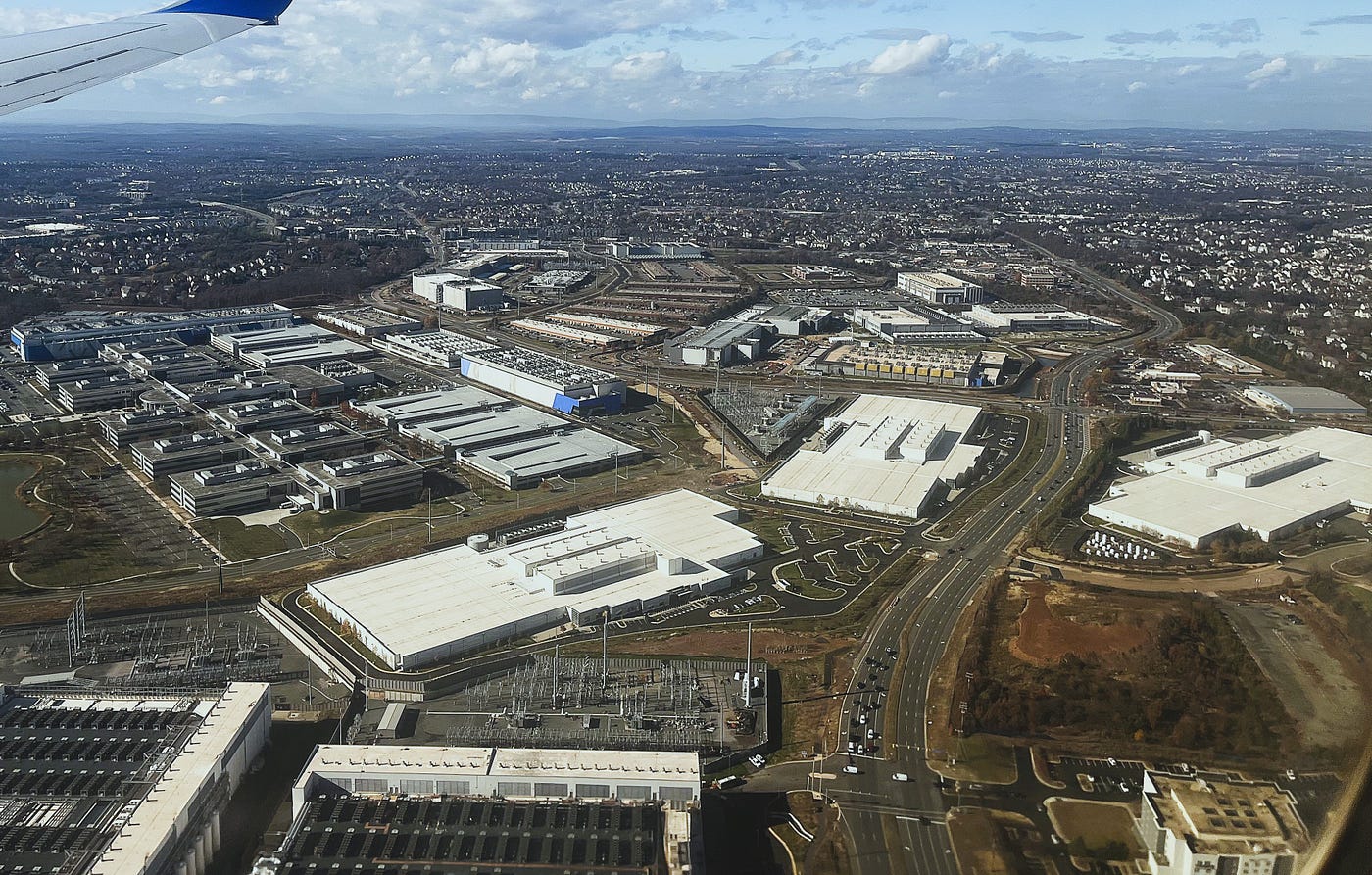
But compare what’s going on in the outer suburbs. Shown above is a satellite view of once-rural land in Loudoun County, Virginia, an outer suburban jurisdiction around 35 miles west of Washington, that has more than doubled its population since 2000, adding around 280,000 residents. Loudoun was once best known as the heart of Virginia’s bucolic “horse country”; while there are still some lovely horse farms left, it is now best known for containing the nation’s greatest concentrations of data centers. Loudoun is now two and a half times as populous as it was 25 years ago.
Are we missing the action?
And, while there are charming historic districts in Loudoun’s older towns such as Middleburg and Leesburg, the bulk of Loudoun’s newer development is nothing more than low-density, very automobile-dependent, residential and commercial (including the data centers) sprawl.
The commercial heart of the new Loudoun is not Middleburg or the county seat of Leesburg, but a shiny new, low-rise, completely automobile-dependent complex called One Loudoun, outlined (a bit faintly) in red on the right side of the satellite photo above. Indeed, its motto is “Loudoun County’s Downtown.”
While my urbanist friends are mulling the future of traditional downtowns — some very optimistic, others not so much — we in the planning business may be missing the point: Places like One Loudoun may be the real downtowns of the future. My extended family members who live in DC’s outer suburbs (and wouldn’t want to live anywhere else) love the place. I joined them at a festive Mexican dinner there last week, as I have done several times before. Here’s what the heart of “Loudon County’s Downtown” looks like on Google Street View:

And here’s what the scene looked like last week as we walked from the parking garage to the restaurant:

The amber brick building in the center of the image was our destination for the evening.
Now, I don’t really want to be picking on Loudoun County (said to have the highest median income in the country, by the way) or even the One Loudoun complex. I had a great time at dinner (if not so much on the 45-minute drive each way from our home in DC). It just happens to be an outer suburb of a large metro area that I know well because of where I live and family connections.
But the story of Washington and its burgeoning outer suburbs is far from unique. It’s being repeated across the country as advocates concentrate on central cities and inner suburbs while the real action is far from downtown. I took a quick look at metro Atlanta (where the formal city has added 112,000 people since 2000, growing 27 percent) and Denver (which has added 186,000, or 34 percent). Central-city development in both metros has done well since the turn of the century. But, as in Washington, densifying already-urban places is not doing much, if anything, to stop sprawl. (Forsyth County, Georgia, about fifty miles northeast of Atlanta, has tripled in population since 2000; Douglas County, Colorado, about forty miles south of Denver, has more than doubled its population in the same time span.)
In the city — and beyond — let’s be real
As I said above, working on the alternatives to sprawl — making better cities and inner suburbs — is important, even if we advocates must learn to compromise along the way. Let’s keep doing that.
But we must bear in mind that we have limited resources and must spend them wisely. In my opinion, we’re not paying nearly enough attention to where the action really is. Those of us in the advocacy world (and in the world of philanthropy that ultimately determines what advocates can and cannot afford to work on) need to develop and implement policies and incentives for better conserving the rural landscape. Once forests and farms are developed, they are lost forever. Once environmental, economic and social harms are inflicted by developing that landscape, they can become very difficult to cure.
Yet we and our colleagues in planning can’t close our eyes to this. We need to pay attention to the real world of twenty-first-century development, and start making places like One Loudoun better before that opportunity, too, is lost forever. Ultimately, what is smart growth (and urbanism, too, for that matter) for, if not for effectively reducing the substantial harms inflicted by sprawl?
This article first appeared on Medium.
