


A Placemaking Journal
Gentle Growth: Can established neighborhoods densify without sacrificing character?




 February 9, 2026
Next time you open the website of a smart growth organization, take a look at the images it features. Chances are you’ll see at least one older neighborhood street with a variety of businesses and/or homes in small to medium-sized buildings. That’s partly because such scenes contain some of the key attributes — such as walkability and a mix of uses — that smart growth organizations advocate, of course. But it is also because these groups know that people love neighborhoods such as these.
For example, take a look at the photo just below, chosen to represent “inclusive, vibrant communities” by the excellent smart growth advocacy organization in the Washington, DC region where I live, the Coalition for Smarter Growth (disclosure: I am a longtime member and supporter). The photo is well-chosen: to me, it looks very much like the kind of exciting, lovable commercial street I want in my community.
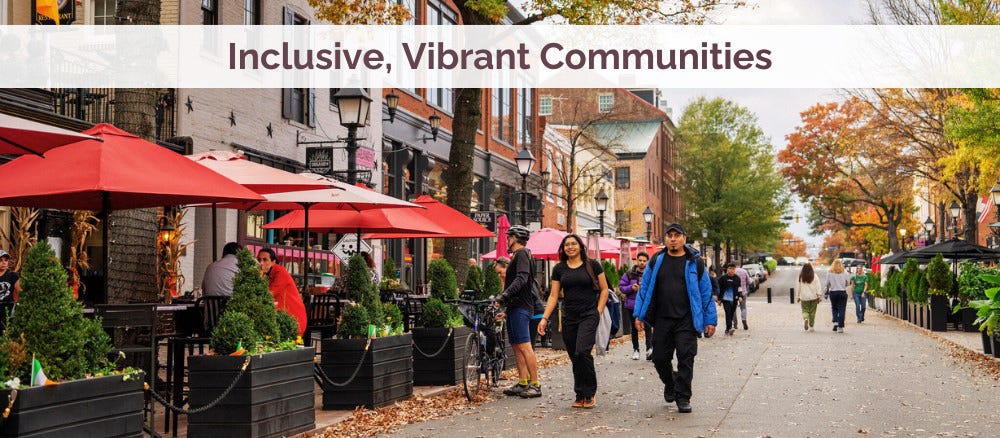
Notice how the buildings are relatively small in width, compared to many newer, larger buildings, and varied in their ages and heights; they range from about two stories to four stories tall. They are what many of us call human-scaled. CSG does not indicate the location, but to me it looks like King Street in the historic Old Town core of Alexandria, Virginia, an older suburb just outside of Washington.
(Editorial note: Some language in this essay draws from my previous publications. For reference, I provide links at the end.)
The leading national organization advocating smart growth neighborhoods, Smart Growth America (disclosure: I was a co-founder and longtime board member, and remain a donor and supporter), does the same thing. Look at the photo below, used on its website to illustrate the kinds of places it advocates.
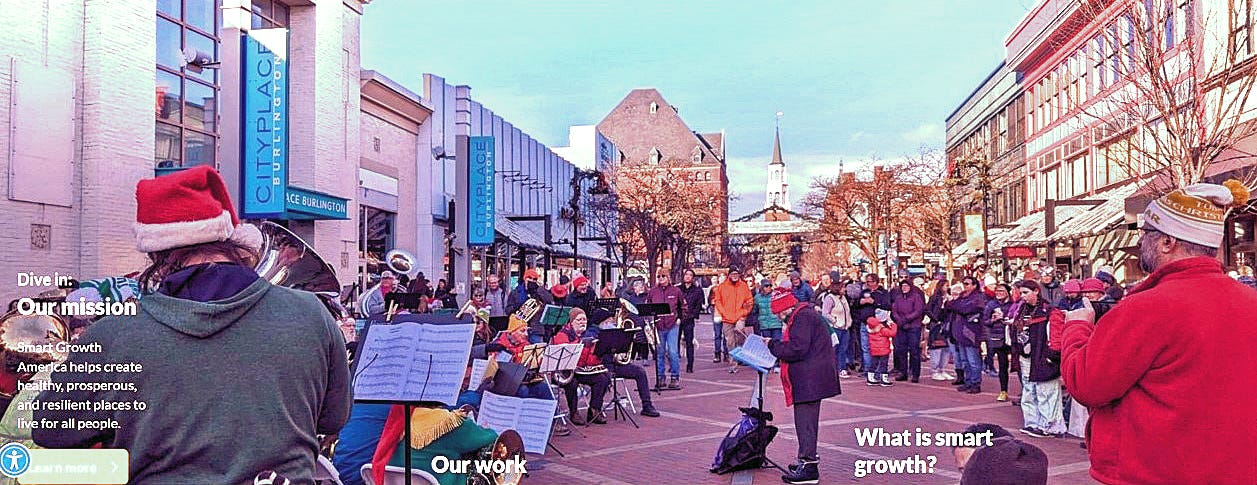
Again, the location is not specified, but I believe the city shown is Burlington, Vermont. Again, notice the variety of building sizes and ages and, above all, the human scale. One building in the background might be as tall as five or six stories; the rest appear smaller.
The appeal of walkable, human-scaled streets and neighborhoods
Here’s another image of a human-scaled, varied commercial street from Smart Growth America, this one a rendering on the cover of the organization’s very good report on policies supporting “complete streets” that safely accommodate cyclists, pedestrians, transit users, and other non-drivers as well as motorized traffic:
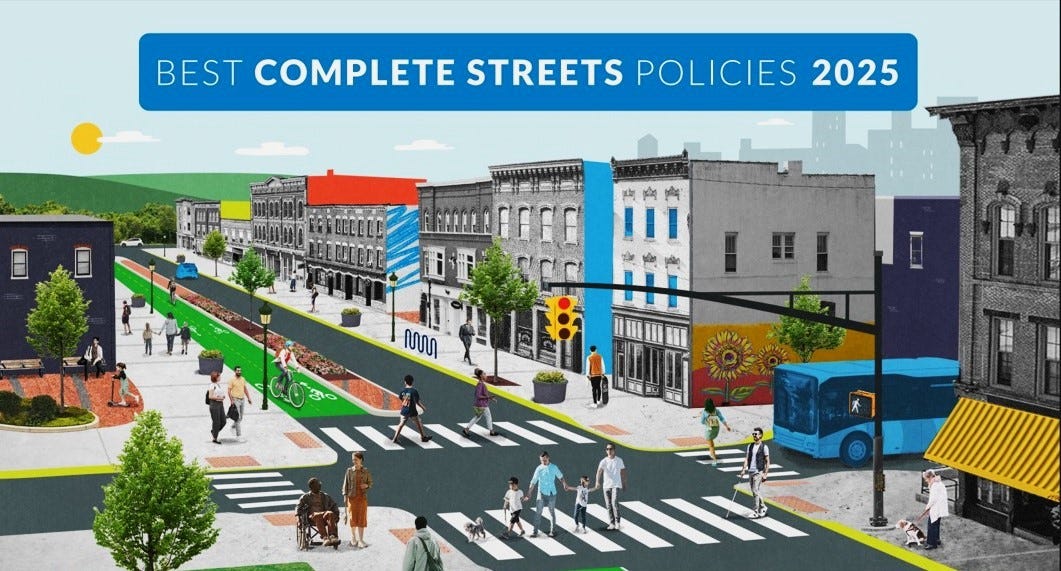
Notice how the largest buildings shown are three stories tall. Advocates for smart growth policies choose images showing varied, human-scaled buildings and streets to promote our work for a very good reason: They make viewers comfortable, thinking “I want to support policies that lead to the construction of neighborhoods like these.” The images show, in effect, “good ambassadors” of what smart growth might look like.
Moreover, neighborhoods that look like these are not just pleasing to the eye and heart. They are demonstrably good for cities, too. A highly detailed study published a decade ago (and reported here) by the National Trust for Historic Preservation demonstrated that, compared to districts dominated by larger, newer buildings, those with smaller and older buildings were found to score better on multiple measures of urban vitality.
Examples beyond those used by advocacy organizations
The city of Washington, DC, where I live, is blessed with many older neighborhoods, and not just in designated historic districts, that also have these kinds of features, with appealing scale. Here’s a photo of a street (Connecticut Avenue Northwest) in DC’s Cleveland Park neighborhood that I walk along often:
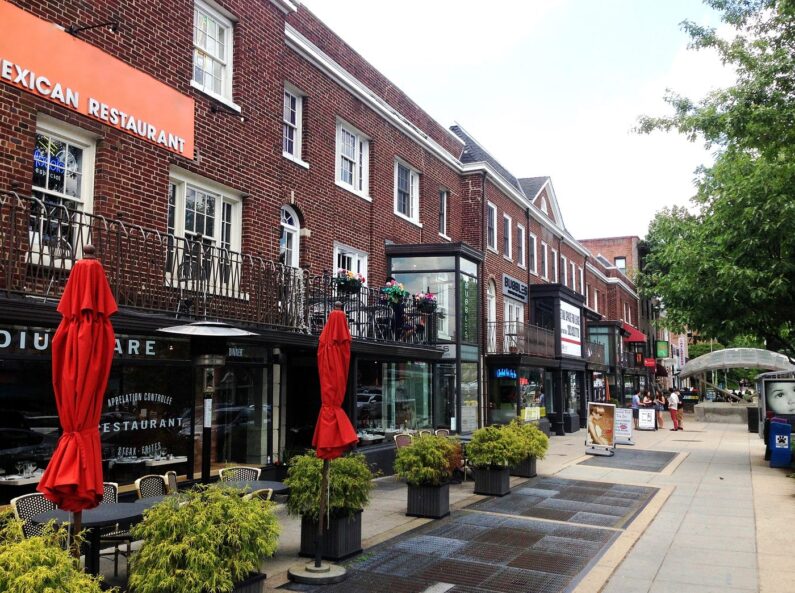
The DC block shown not only has an attractive “Main Street” feel but also features great walkability. (The Walk Score of the Mexican restaurant in the foreground is 90 as of this writing.)
Other large cities have great-looking, older human-scale neighborhoods, too. Here’s a portion of Charles Street in Boston:

My feeling is that, where we have attractive, older neighborhoods like these, we shouldn’t mess with them too much. Sure, they may contain some one- and two-story buildings mixed in with somewhat taller ones, but what matters is a range of building types that add up to a pleasing, varied walkable density.
We may indeed want to add some more housing or other uses in these locations at slightly taller scales, but we shouldn’t do that insensitively or uniformly, in my opinion: it’s the variety that makes walkable neighborhoods pleasing, that makes people flock to historic districts, even those abroad in other countries. The cover of my book People Habitat features a walkable, human-scaled neighborhood in Copenhagen:
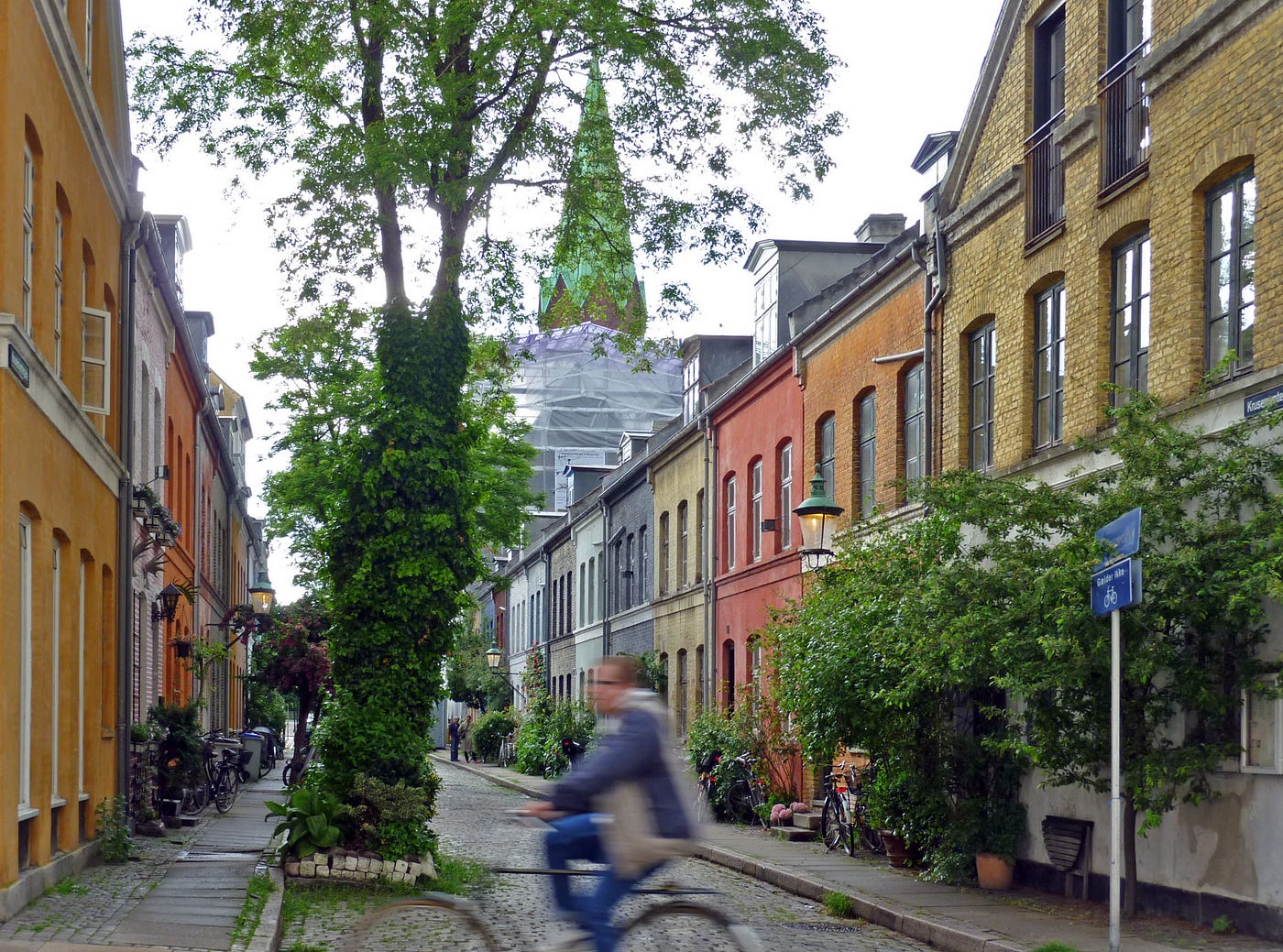
The great Danish architect and walkability guru Jan Gehl would likely conclude that the building heights shown in the images above are about right to facilitate enjoyable walking, to “optimize the pedestrian experience,” to use architectural jargon. After extensive study of how humans behave in different kinds of environments, Gehl has concluded that the most comfortable building height for urban pedestrians is between 12.5 and 25 meters, or about three to six stories. (See the excellent discussion in Chapter 2.3 of Li Teng, Human Scale Development. Warning: lengthy pdf.) Could this be part of why people love these historic city districts so much?
I’m not going to argue that we should never build above five or six stories (although some renowned architects, notably the late Leon Krier, have : “The most beautiful and pleasant cities which survive in the world today have all been conceived with buildings of between two and five floors”.) I can go higher, especially in the right context. Heck, I have myself lived happily in ten-story buildings in the right context. The excitement of Midtown Manhattan is unthinkable without the context of tall buildings.
But I do think that, in our passion for higher densities as an antidote to low-density sprawl, too many urbanist advocates overlook the considerable benefits of still-relatively-high city density at a human scale.
Indeed, consider the environmental benefits of density, which has been shown to reduce the amount of runoff-causing impervious surface in watersheds (because of the huge amount of transportation-related pavement required to serve sprawl) as well as to reduce driving rates per capita, compared to sprawl. I’m going to try to avoid getting overly tech-y about it here, but the research shows that these benefits are found mostly at the lower end of the density spectrum; environmental gains per capita begin to diminish at a density of about 20 homes per acre, and there is little additional benefit to these indicators as density increases beyond about 60 homes per acre.
But does newer development match up with what we advocate?
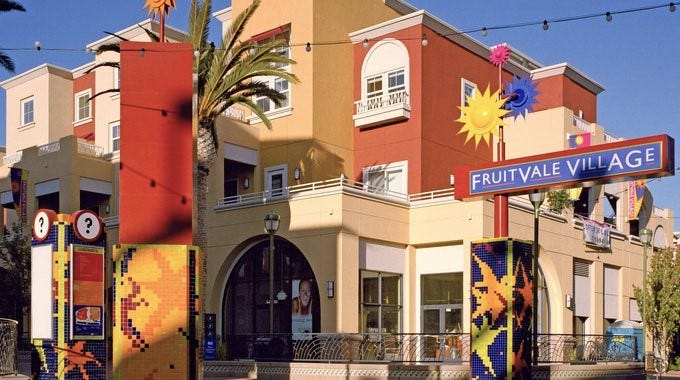
The good news is that there are some terrific examples of recently built, urban, smart growth development assembled at a human scale similar to that of well-liked historic neighborhoods. One of my favorites is shown below. Fruitvale Village in Oakland, California, is a mixed-use, mixed-income, transit-oriented development built next to a BART rail transit station. It’s mostly three and four stories tall and, importantly, modulated in its dimensions so that residents, visitors, and pedestrians enjoy a variety of facades and sight distances. I have visited the complex and found it delightful.
But it’s not all good news. Unfortunately, a lot of what is being built in the name of smart growth — whether advocated directly by smart growth and urbanist organizations or not — these days is far less human-scaled and, to my eye, far less appealing. The two buildings shown just below, for example, sit in Arlington, Virginia, right on top of a Metro rail transit station across the Potomac River from the formal city of Washington, DC. The new development contains hundreds of new transit-accessible housing units and offices, just as many advocates, here and elsewhere, lobby for.
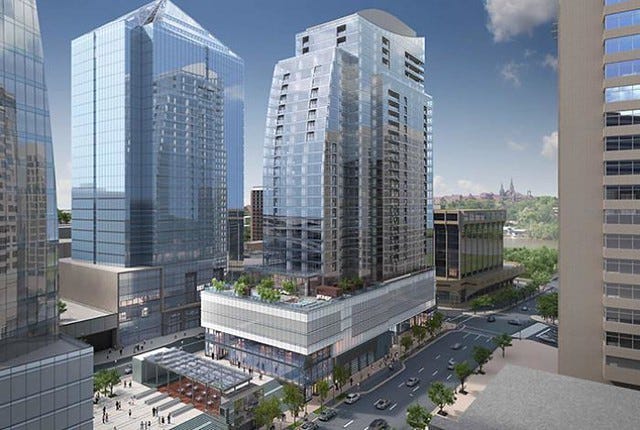
But you are highly unlikely to see a development such as this one featured as a feel-good ambassador for smart growth on the home page of a leading advocacy organization. These organizations’ communications people know better than to trot out exactly what many people fear being built in their neighborhoods.
Now, it must be said that, for many people, buildings such as these may be fine places to live or work. The apartments (and offices, too), for example, might be quite nice, with good views, plenty of room, modern fixtures, and all sorts of amenities either within the complex or within easy walking distance. I certainly enjoyed living in well-located large apartment buildings in DC when I was younger.
And, environmentally, they enable reductions in driving and associated emissions. The particular rail transit line (Metro’s Orange Line) that extends westward from this particular development has a demonstrably stellar record of accommodating significant population growth with little increases in motorized traffic.
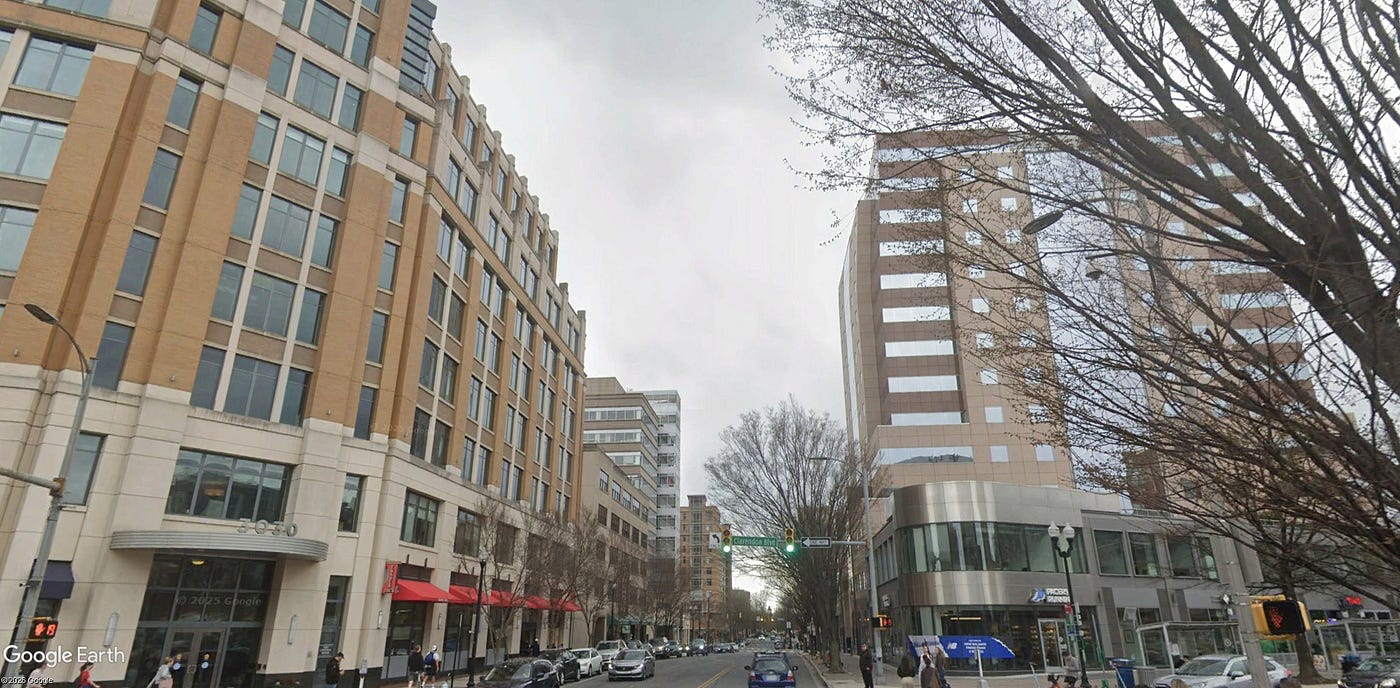
But few residents of older, currently human-scaled neighborhoods want buildings this large next door. Here are two more clusters of newer buildings on the same transit line:
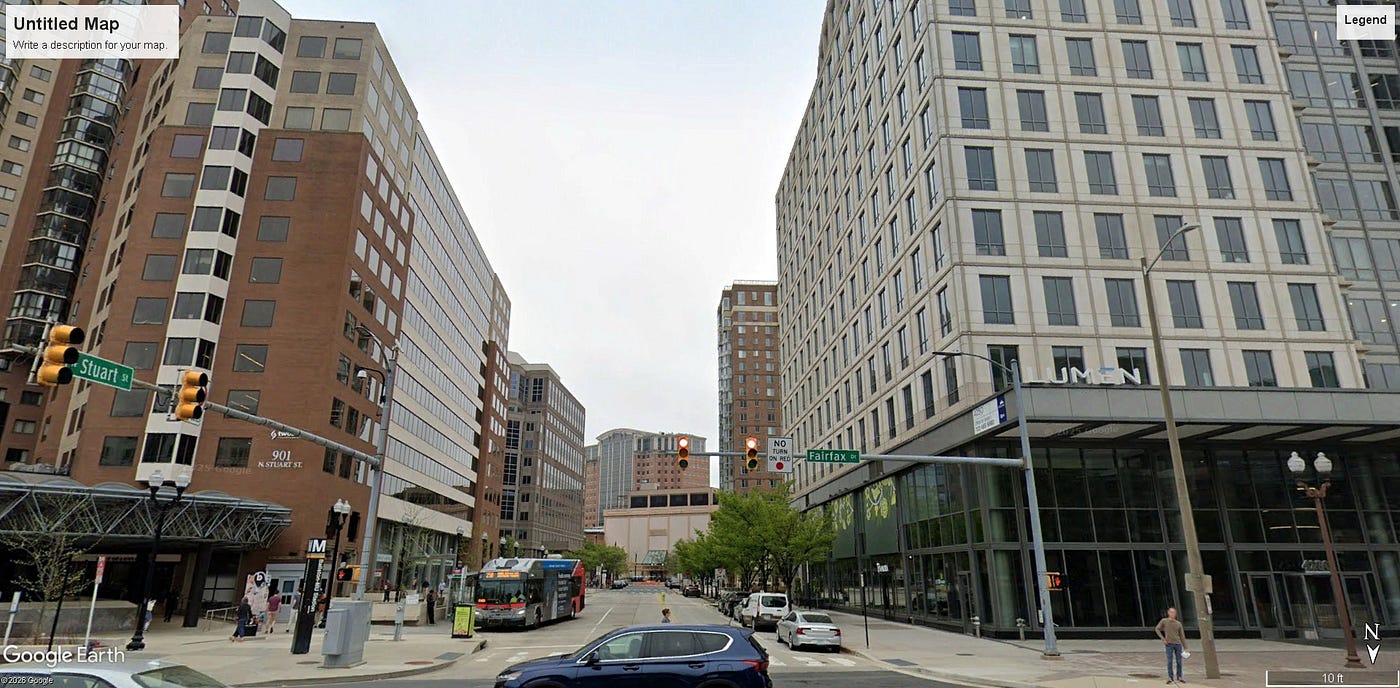
And here’s one in the District of Columbia near the US Capitol building:
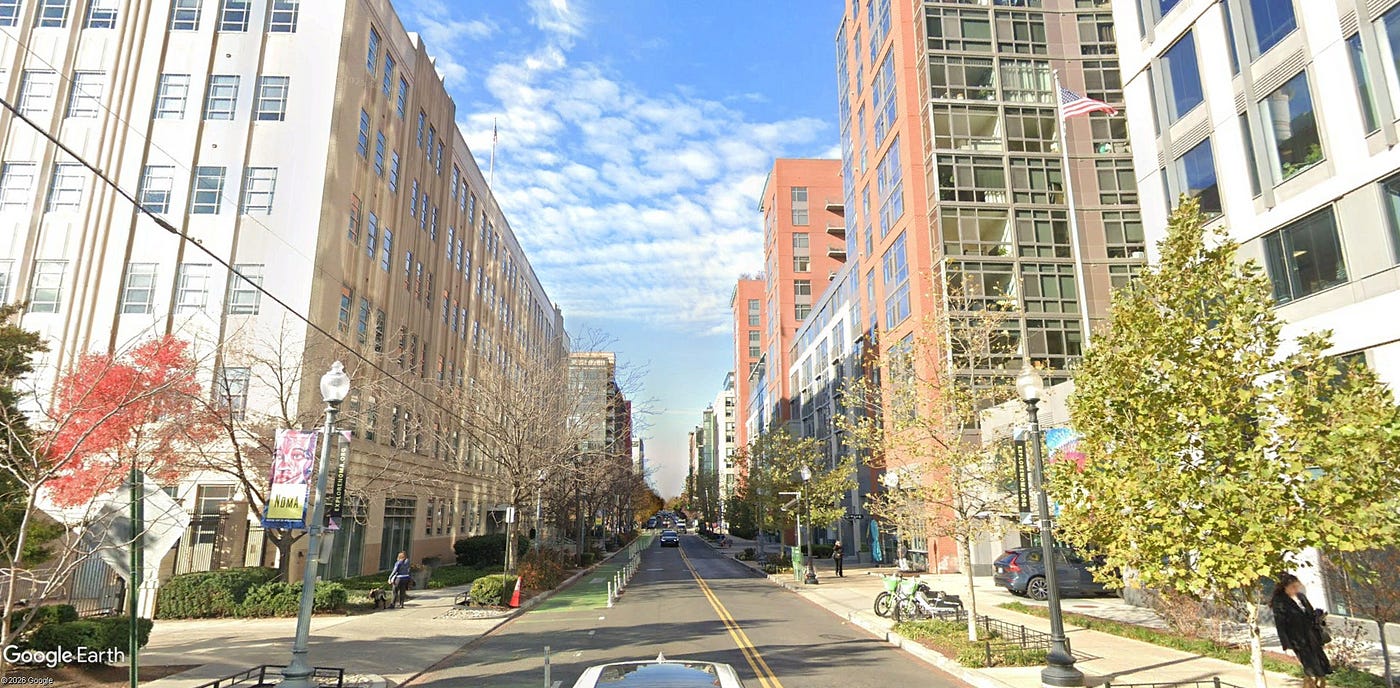
The blue sky and sunshine help in the last photo, don’t they? And there is at least some architectural modulation in the buildings shown on the right side of the street. But do the four scenes shown just above look anything like the scenes featured on the websites of the smart growth advocacy organizations that this essay begins with? To me, they look like “Anywhere, USA” places devoid of identifying cultural characteristics.
If we as promoters of greener, healthier places entice supporters with images of human-scaled development while lobbying for places such as the ones just depicted, we are being a bit disingenuous.
Again, all of these newer places shown may be good, even great, places to live or work. I am not disputing that, nor am I necessarily disputing that such buildings may belong in the places where they are located. My argument is, rather, that they are not harmonious in style or scale with many older, human-scaled neighborhoods in the DC region and elsewhere that people have come to love. I believe that, in these places, we must take care to build — if we must — more sensitively.
The thorny issue of affordability
The elephant in the room, however, when writing an essay on harmonious, human-scaled development — especially in the DC metro area — is affordable housing. There is an emerging consensus among observers that there is a significant shortage of housing, especially affordable housing, in the United States.
There seems to be little question that housing costs have risen faster than incomes in recent decades. In a recent article published in The New York Times, Nate Cohn writes that housing affordability is the number one issue of concern nationally among Americans in their twenties:
“Housing stands out as the problem that’s most on the minds of young people. In an open-ended poll question, around half of them said they worried most about affording housing, more than every other item combined, including retirement, health care, education, bills, cars and food. Only 36 percent of young people said the home they would like was ‘within reach’ (or they already owned it), compared with 76 percent of those over 65.”
However, another national poll of voters of all ages, reported recently by Peter Whoriskey in The Washington Post, found that it is the cost of health care that is the nation’s foremost affordability concern, topping the cost of food (the number two concern) and housing (number three).
Personally, my own experience tells me that the high cost of housing may not be as new a problem as many seem to think. I was well into my thirties before I was able to scrounge together enough money to afford a down payment and begin home ownership with a small condo. In my twenties, I lived in group houses, rented apartments and, with my partner, a rented townhouse in dire need of updating. As I advanced in the workforce, my salary grew, and I was able to pay off student loans and gradually work my way up the ladder. It seemed a natural progression to me.
Do today’s young people expect more than I did? Is lack of housing affordability more a problem of stagnant wages than of insufficient housing supply?
Whether or not expectations are reasonable, the perception that we have a significant problem of housing unaffordability is a strongly held one. And that prompts the question of whether the kind of development espoused by Jan Gehl and Leon Krier, and that I personally prefer, is compatible with the provision of affordable housing.
What does the DC example suggest?
There is plenty of affordable housing in many parts of our country, but not necessarily in the places in which it is considered most desirable to live. In recent years, Washington, particularly within the city limits, has been considered to be one of those places, and it can indeed be expensive to live here. Desirable places always command higher prices; that is simply a fact of capitalism.
But whether DC’s housing prices remain as high as they are now — whether demand for Washington homes will remain this strong — may, unfortunately, be an open question. Personally, I’m rooting hard for a strong local economy. However, the city is losing many jobs that attract bright young people here.
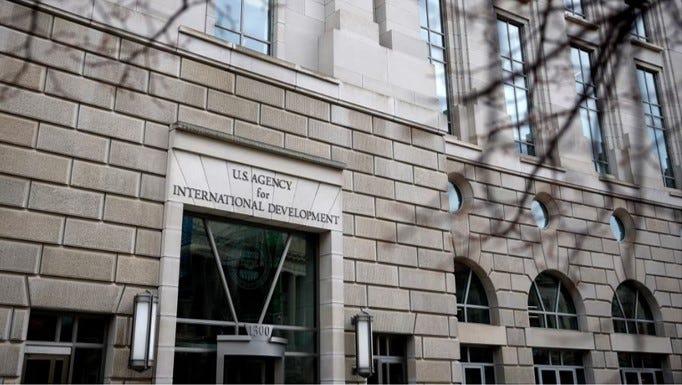
For example, a lot of federal agency jobs, long the backbone of local employment, have been lost due to a recent trend, sometimes a dramatic one, towards downsizing. Entire agencies, such as the US Agency for International Development, have been eliminated altogether (although a small number of its programs survive in other offices). Other employers in both the public and private sectors have shifted more of their workforce to remote working some or even all of the time, resulting in de facto empty or half-empty buildings all over the city.
Partly as a result, retail has suffered greatly in DC (and elsewhere), not only because of fewer nearby customers but also because the nature of retail is changing, bit by bit, away from brick-and-mortar stores and toward more online shopping and home delivery. This, too, weakens the attractiveness of the core city and decimates small businesses dependent on nearby customers. According to an article written at the end of last year by Tim Carman, Emily Heil, and Warren Brooks, and published by The Washington Post, 92 full- and limited-service restaurants in Washington closed in 2025, nearly 20 more than 2024’s 73 closures.
Data on liquor licenses suggests that the number of closures may be even higher: The same article reports that 210 restaurants and taverns canceled their liquor licenses in 2025, generally considered a sign that facilities are closing. (While this number is partially offset by the granting of some new liquor licenses in 2025, there was still a net loss of 126 licensed restaurants and taverns, a loss worse than that experienced during the pandemic.)
Anecdotally, local real estate agents tell me that housing prices in the DC market have indeed softened. This may be due in part to the fact, while Washington’s suburbs continue to grow rapidly, the previously experienced robust population growth inside the city has recently flattened. (DC’s population also remains below its pre-pandemic level.)
On the commercial side, someone I know in the commercial real estate business tells me that the market for DC office buildings is cratering, with buildings rapidly losing value and their owners in danger of defaulting on their loans. Many are attempting to renegotiate those loans and accepting that they will lose a lot of money in the process.
In any event, DC has not done badly in adding new housing in recent years. At the beginning of Mayor Muriel Bowser’s second term in 2019, she announced a goal of adding 35,000 new housing units to the pre-existing stock by 2025.
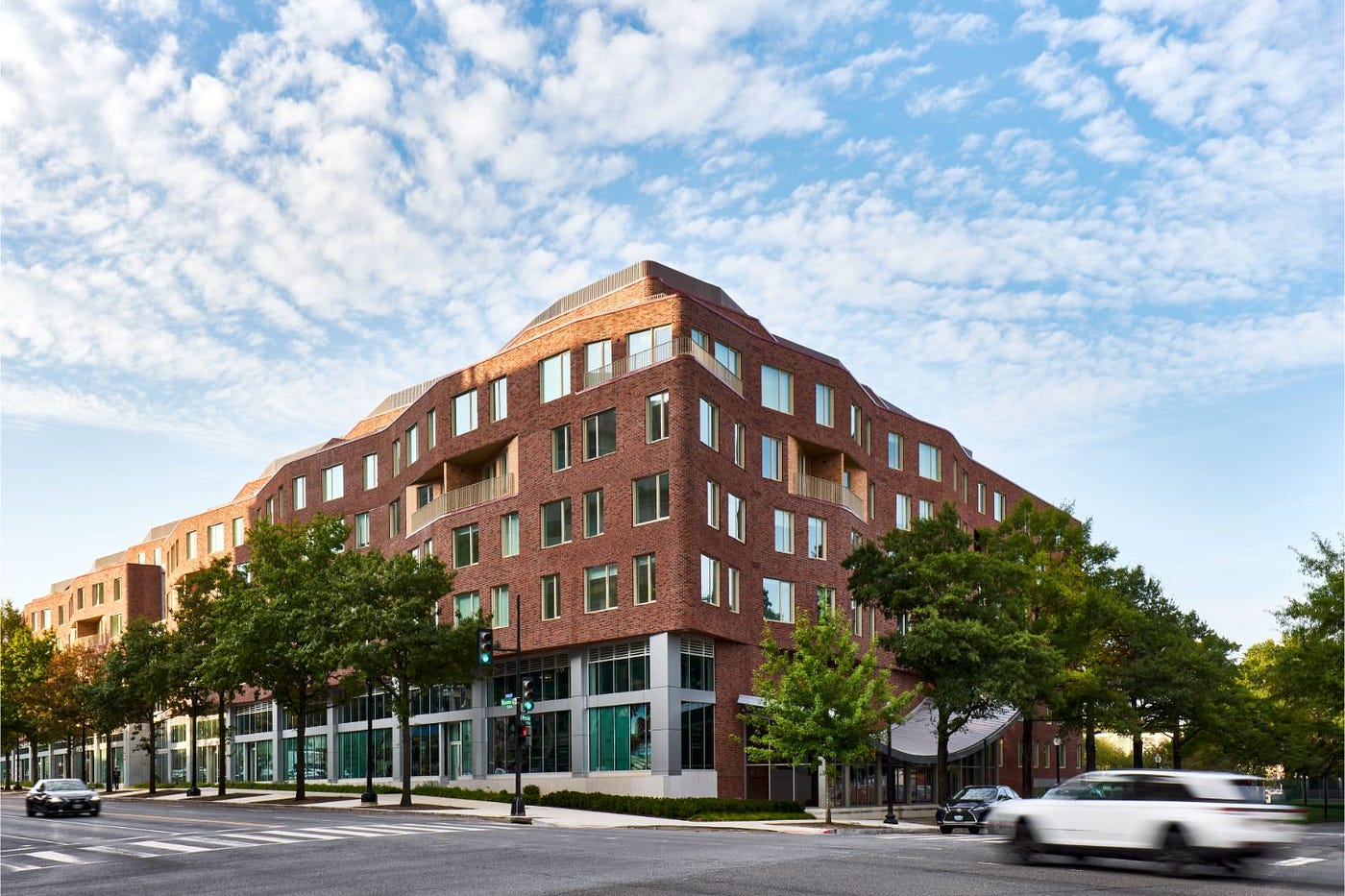
In fact, that goal was substantially met and exceeded, with the addition of over 40,000 new units by the end of 2025. That’s impressive. Heck, over two thousand new apartments either have been built or are nearing completion just in my part of the city, within easy walking distance of my house in Northwest Washington.
But will adding market-rate homes bring down prices?
The problem remains, however, that very few of these new units in DC are priced to be affordable. Citywide, the mayor’s goal of adding 12,000 new units of affordable housing has still not been fully met; as of the end of 2025, 10,515 new affordable units (88 percent of the target) had been added. (See the above link, which is updated monthly).
In my opinion, the best way to make housing more affordable is to subsidize it. But, if sufficient funds or the political will to do enough of that is lacking — as so far seems to be the case in DC and elsewhere — the question becomes whether adding luxury and other market-rate units to the overall housing supply can by itself lower prices enough so that workforce buyers/renters and others who cannot afford top prices will be able to obtain housing that is now out of reach.
A related question is whether regulatory constraints such as restrictive zoning are preventing more housing to be built and thus keeping prices high. Ardent YIMBY (“Yes in My Back Yard”) activists — including folks I like and respect tremendously — and a growing number of sympathetic politicians insist that the answer to both questions is an unequivocal yes. Classical economic theory, they argue, is applicable: for a given amount of demand, when the supply of a good increases, its price will fall, and vice versa. If demand increases while supply is constrained, prices will rise.
There are data to support this point of view, though studies vary on the extent to which the classical economic model applies at the neighborhood scale, and on how much and how quickly adding market-rate housing might bring costs down for people who need more affordable options.
One of the best analyses I have seen in support of the benefits of adding more market rate housing was published in 2025 by the Pew Charitable Trusts. It finds that every ten percent increase in a market’s housing supply is correlated with rents growing five percent less (albeit still growing). At the neighborhood level (using zip codes as proxies), a ten percent increase in housing supply means that rents will grow 1.4 percent less than in a neighborhood with no supply growth at all. That’s obviously not a huge amount; but I suppose that, for people on the margin, it might help some.
Skeptics argue that, in the case of urban housing, the classical theory does not necessarily apply, because the classical equation focuses on housing units rather than the rising value of land (see a good summary here), or because of the wide disparity of wealth in the US, or because the benefits of adding high-end supply do not trickle down to those most in need of more affordability.
In DC, the numbers so far seem to suggest that adding a significant amount of housing has little if any effect on housing prices, except for those units designated and subsidized to be affordable. A developer friend who specializes in the provision of affordable housing (his portfolio reflects the building of over 19,000 affordable and mixed-income homes) has told me that public subsidy has been markedly essential to his best work. Another friend, a celebrated architect who has spent over half a century advocating walkable urban density, tirelessly promotes increased building for other reasons, but insists that (I may be paraphrasing a little, from memory) “we absolutely cannot build our way into affordability.”
I have discussed the relationship between housing supply and affordability at length in a previous essay on urbanism and need not repeat that discussion here. Some of the most interesting skeptical analysis of the issue that I have seen recently is in a new (January 2026) scholarly paper published by the London School of Economics (authored by Professor Thomas Storper from that institution, along with scholars from UC-Berkeley, the University of Toronto, and Georgia Tech). The authors argue that “trickle-down benefits from deregulation will be insufficient and too slow” to make a meaningful difference. This quote from the 45-page paper’s abstract is worth presenting in full:
“A popular view holds that declining housing affordability stems from regulations that restrict new supply, and that deregulation will spur sufficient market-rate construction to meaningfully improve affordability. We argue that this ‘deregulationist’ view rests upon flawed assumptions. Through empirical simulation, we show that even a dramatic, deregulation-driven supply expansion would take decades to generate widespread affordability in high-cost U.S. markets. We advance an alternative explanation of declining affordability grounded in demand structure and geography: uneven demand growth — driven by rising interpersonal and interregional inequality — is the primary driver of declining affordability in recent decades. For cost-burdened households, trickle-down benefits from deregulation will be insufficient and too slow.”
The full paper can be found here. But a shorter explanation, by San Francisco-based investigative reporter Tim Redmond, has been published here, with graphics.
Building with compatible, sensitive design and scale
Wherever one comes out on the deregulation-for-affordability arguments, let’s suppose that we do want to add some housing or other development to an already-established, human-scale neighborhood. My hope is that we can do so sensitively, preserving the human-scale attributes that make such neighborhoods attractive and lovable.
And I believe we can. One of my favorite ways to do that, while remaining well within the building-height parameters espoused by Jan Gehl and Leon Krier, is through a type of development called “Missing Middle” housing — though its principles can be applied to commercial development as well. Missing Middle comprises a range of building types in the middle between detached, single-family homes on one end of the spectrum and much larger and taller multifamily apartments and commercial buildings on the other.
The range is called “missing” because this middle range, while once common in the United States, is seldom built anymore, except perhaps in the case of townhouses. Here the range is beautifully illustrated by Opticos Design, California-based architects and designers who champion and specialize in the concept:
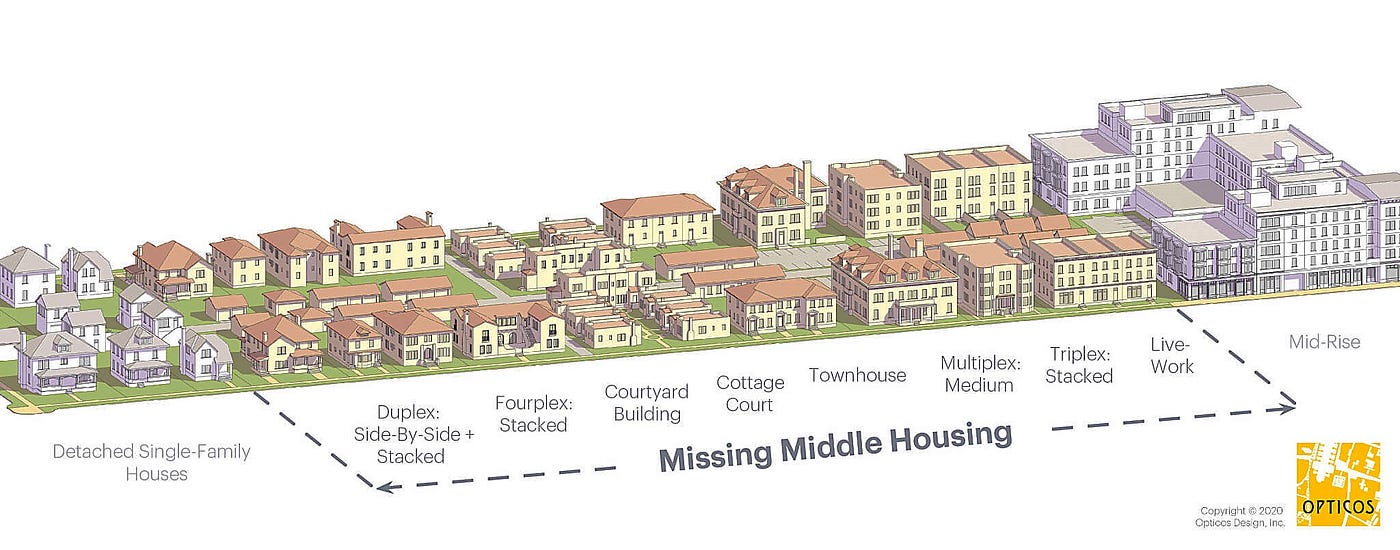
Note the large range of building types and sizes, as well as how the buildings at the upper end of the range can add, if desired, a significant bit of density to a neighborhood without overwhelming it. There is a lot of detail concerning the various options on the Missing Middle website maintained by Opticos, summarized nicely here:
“The Missing Middle Housing types provide diverse housing options, such as duplexes, fourplexes, cottage courts, and multiplexes. These house-scale buildings fit seamlessly into existing residential neighborhoods and support walkability, locally-serving retail, and public transportation options. They provide solutions along a spectrum of affordability to address the mismatch between the available U.S. housing stock and shifting demographics combined with the growing demand for walkability.”
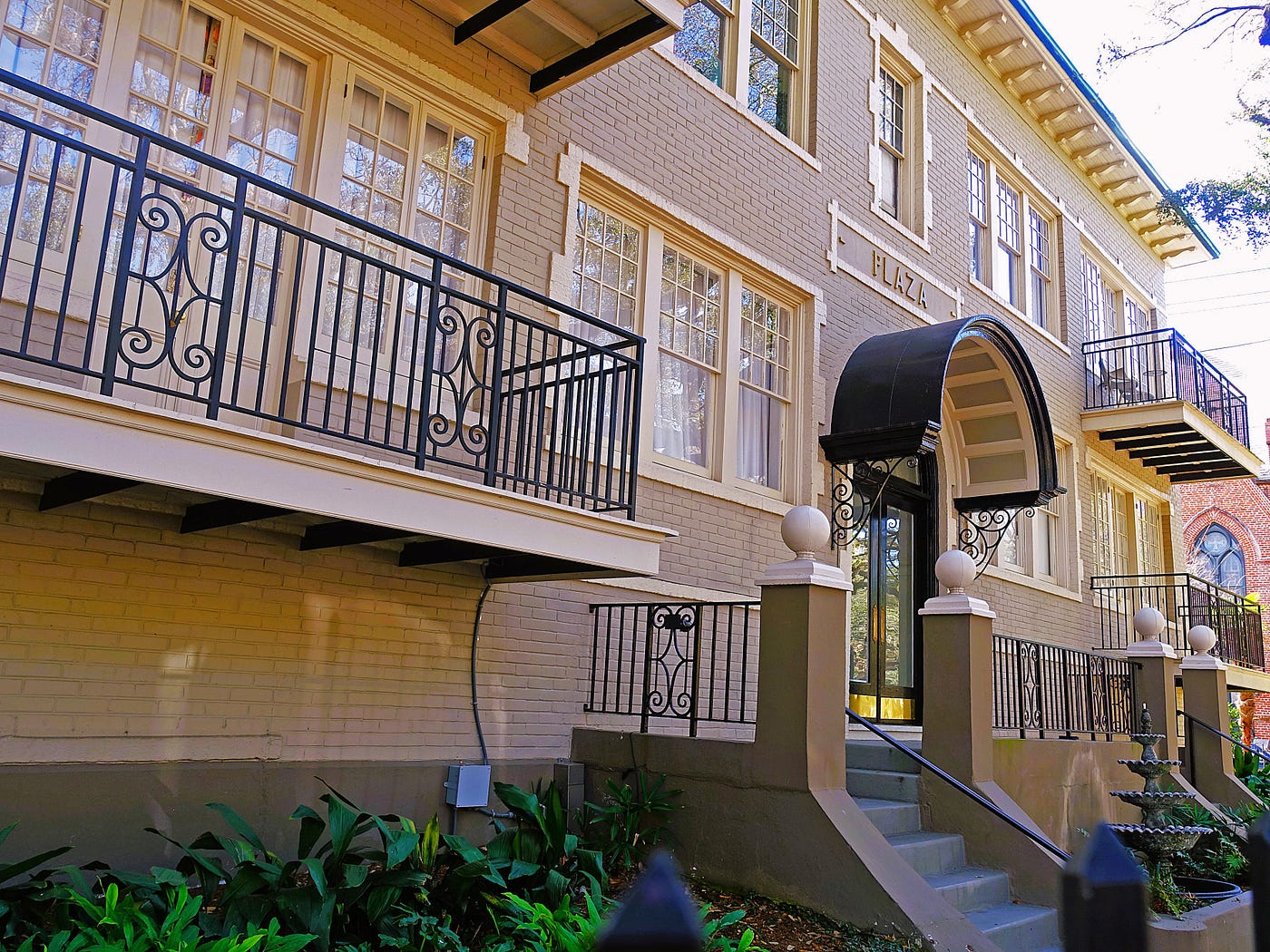
In Washington, we already have quite a bit of housing that fits within the missing middle spectrum, providing precedent for building more at that scale. Consider, for example, this three-story apartment building nicely nestled among single-family homes:

There is also substantial precedent in Washington at the lower end of the missing-middle spectrum in the form of what locals call semi-detached homes (and most might call duplexes) such as these:
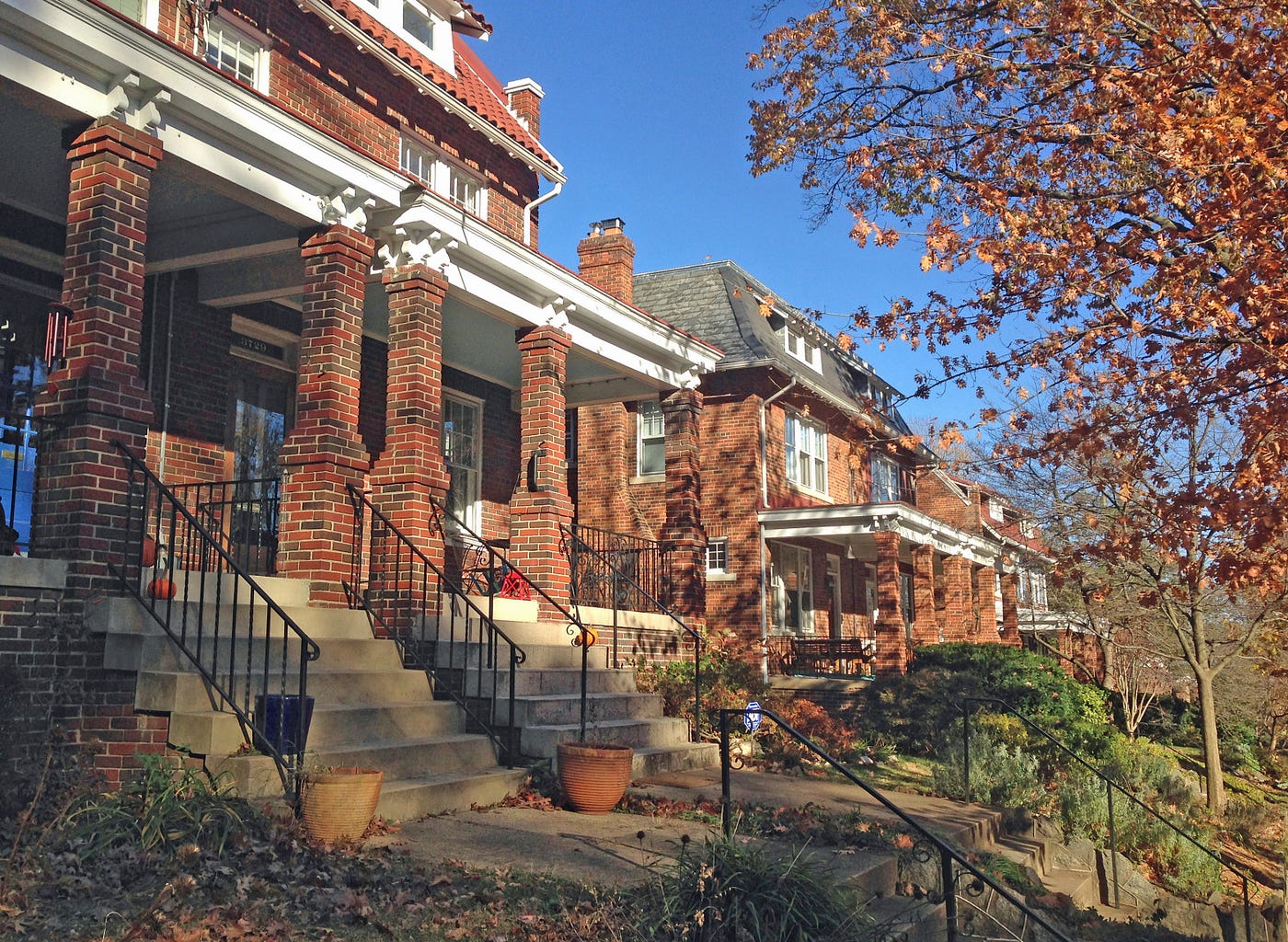
(In my vocabulary, I tend to distinguish semi-detached homes from true duplexes because they are separately owned, as are the small lots they sit upon. But it may actually be just a distinction in regional vocabulary.) Many of these homes also feature accessory dwelling units, frequently created from converted garages and basements, many priced to be quite affordable. The semi-detached model is found in every corner of the city.
Now, I’m not going to pretend that all of these homes would qualify as “affordable” even when located in expensive neighborhoods. As with every other type of home, prices for semi-detached homes vary widely by location, but they are almost always much lower-priced than detached, single-family homes in the same locations. Fourplexes are also found in many older Washington neighborhoods (Glover Park comes to mind), as are virtually all other types on the missing middle spectrum.
My bottom line
These are serious issues, with the potential to dramatically change the character of much-loved neighborhoods in our communities. Can we build new housing more gracefully? I believe that we can and should tread carefully in bringing new development to existing human-scale neighborhoods and, when we do add new construction, show respect for the time-honored principles that make human scale attractive and lovable.
In addition, most smart growth and urbanist organizations — including the ones I support and have mentioned here — do fantastic work to improve the places where we live, work, and play. But, when we show human-scaled neighborhoods in our organizations’ communications to illustrate what we mean by “smart growth” or “inclusive, vibrant communities”, we should practice what we preach by advocating for more of them.
(As noted above, some language in this essay has been published before, on the now-defunct Switchboard blog of my former employer, the Natural Resources Defense Council, and on HuffPost. I retained the copyrights in both cases, and current housing debates prompt me to repeat the arguments verbatim in certain sections of this essay.)